
Understanding Diffusion Models I: A New Frontier in Generative AI

Generative AI has made remarkable strides in recent years, with models like Generative Adversarial Networks (GANs) and Variational Autoencoders (VAEs) capturing much of the spotlight. However, a new type of model, known as diffusion models, is emerging as a powerful alternative for generating high-quality, diverse data. This article provides a beginner-friendly introduction to diffusion models, explaining how they work, their applications, and how they differ from other popular generative models like GANs and VAEs.
What Are Diffusion Models?
Diffusion models are a class of generative models that generate data by reversing a diffusion process. This might sound complicated, but the idea is fairly intuitive when broken down.
Imagine you have an image and you start adding noise to it, gradually making it more and more random until it looks like pure noise. This process is called forward diffusion. Now, imagine you could run this process in reverse, starting with pure noise and gradually removing the noise in a controlled way to recover the original image. This reverse process is the essence of a diffusion model.
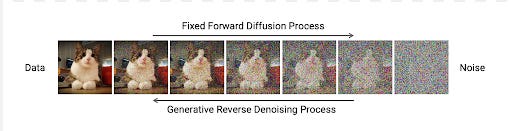
In mathematical terms, diffusion models work by learning the distribution of data (like images, audio, or text) by slowly converting it into noise and then reversing that noise back into data.
How Do Diffusion Models Work?
Diffusion models operate in two key phases: the forward diffusion process and the reverse generation process.
1. Forward Diffusion Process
In the forward process, a clean data sample, such as an image, is incrementally corrupted by adding small amounts of Gaussian noise over many steps. As this process continues, the data becomes increasingly noisy until it is indistinguishable from random noise.
Formally, if we denote the data by x0 and the noise-added data by xt at each step t, the forward diffusion can be described as:
Here, βt represents a small, increasing noise coefficient at each step, and ϵ is the random Gaussian noise added.
2. Reverse Generation Process
The reverse process involves starting with a random noise sample and gradually removing the noise to recover the original data. This is done by training a neural network to predict the noise at each step, allowing the model to subtract the predicted noise and move closer to the original data distribution.
The core challenge in diffusion models is accurately estimating this noise during the reverse process. The model is trained to minimize the difference between the predicted and actual noise at each step, ensuring that the reverse process reliably generates high-quality data.
Applications of Diffusion Models
Diffusion models have shown tremendous promise in various generative tasks, often surpassing GANs and VAEs in terms of sample quality and diversity. Some key applications include:
1. Image Generation
Diffusion models have been particularly successful in generating realistic and high-resolution images. For example, DALL-E 2, an advanced image-generation model by OpenAI, incorporates diffusion techniques to create detailed images from text descriptions.
2. Text-to-Image Synthesis
These models can convert text descriptions into corresponding images, enabling applications in content creation, advertising, and design. The process is more robust than previous models, often producing higher-quality results.
3. Audio and Speech Synthesis
Diffusion models can also generate high-fidelity audio, such as music or human speech. By applying diffusion processes to audio waveforms, these models can produce more natural and diverse sound samples than traditional methods.
4. Video Generation
Emerging research is exploring the use of diffusion models for video generation, where the challenge is to maintain temporal coherence across frames while generating realistic video sequences.
How Diffusion Models Differ from GANs and VAEs
Diffusion models represent a significant shift from earlier generative models like GANs and VAEs, each of which has its own strengths and weaknesses.
1. GANs (Generative Adversarial Networks)
GANs consist of two neural networks, a generator and a discriminator, that compete against each other. The generator creates data samples, while the discriminator evaluates them, trying to distinguish between real and fake data. This adversarial process continues until the generator produces data that is indistinguishable from real data.
Key Differences:
Training Stability: GANs are notoriously difficult to train due to their adversarial nature, often suffering from mode collapse where the generator produces limited varieties of samples. Diffusion models, by contrast, are generally more stable during training.
Sample Quality: While GANs can generate highly realistic samples, diffusion models often achieve even higher quality, especially in generating detailed, high-resolution images.
2. VAEs (Variational Autoencoders)
VAEs encode input data into a latent space and then decode it back into data, while ensuring the latent space follows a known distribution (usually Gaussian). This approach allows VAEs to generate new samples by sampling from the latent space.
Key Differences:
Sample Diversity: VAEs are less prone to mode collapse than GANs, but they often generate blurrier samples compared to GANs and diffusion models. Diffusion models tend to produce more diverse and sharp images.
Training Complexity: VAEs are generally easier to train than GANs but might require more careful tuning to achieve good sample quality. Diffusion models, despite their complexity, have been found to be relatively straightforward to train for high-quality results.
Why Are Diffusion Models Important?
Diffusion models offer a powerful alternative to GANs and VAEs by combining stability in training with the ability to produce high-quality, diverse samples. They are particularly important in areas where generating highly detailed and realistic data is crucial, such as in image and audio synthesis.
Moreover, the flexibility of diffusion models allows them to be applied across various domains, including image, audio, and video generation, making them a versatile tool in the generative AI toolbox.
Conclusion
Diffusion models represent a new frontier in generative AI, offering a fresh approach to creating high-quality data by reversing a noise diffusion process. While they differ significantly from GANs and VAEs, diffusion models are increasingly proving their worth in applications ranging from image and audio generation to text-to-image synthesis. As research continues to evolve, diffusion models are likely to become even more integral to the future of AI-driven content creation, setting new standards for what generative models can achieve.